Showing posts with label programming. Show all posts

Saturday, August 23, 2025

The eternal awkwardness of the minstrelsy legacy, or, opportunity knocks

I haven’t posted here in ages. I have a backlog of topics, but I’ve been overwhelmed by other aspects of the project. And by the larger things happening the last 10 months, which make it feel small and challenging to post about the trials and triumphs of my little endeavor. But it’s time. Here’s a bagatelle that’s maybe obliquely timely in this moment when many of our leaders are dedicating themselves to making racism great again.

I was telling my son about one of the town-themed pieces for my Norwich concert. Norwich is home to the King Arthur Baking Company. So I found a piece from 1896, the year the brand was launched: the aptly but cringily titled “Remus Takes the Cake”, a turn-of-the-century cakewalk, complete with a thick-lipped caricature on the sheet music cover. 

My son said “well that’s not at all problematic”. 

Now, cakewalk has a troubling resonance, above all here in Vermont. But music professor that I am, I had to expound on its complex cultural connotations. The dance originated on Southern plantations, where enslaved Africans saw the whites opening their soirees with a “grand march” and were inspired to parody the very proper and very simple dance of their oppressors. Dressed in the finest clothes they could manage, they mimicked the two-by-two parade-style dance, mocking the basic and formal steps of the white folks while simultaneously jazzing them up with virtuosic flourishes. And they turned it into a competition, with the winner of course “taking the cake”.

Before long the white folks witnessed these satires, and rather than take offense, they sponsored and then imitated the slaves’ spoof of their own dance, in turn caricaturing the ragtag “formal” clothing and (notoriously) the stereotypical African physiognomy as well by making themselves up in blackface. The reflections don’t stop there: when the minstrel show came into being in the 19th century, traveling Black performers bizarrely adopted one aspect of the white owners’ imitation of their slaves’ satire of their masters’ formal dance: they performed in blackface themselves. And this is the iteration that white fraternity and sorority students were emulating when they performed in UVM’s annual Kake Walk, one of the most lavish, elaborate, and long-lasting instances of the tradition, which continued—in blackface—under increasing protest until finally abandoned in 1970.

So that, I concluded, is the nuanced history of the genre, one of many instances where cultural exchange, no matter how involuntary, brutal, and violent, has borne rich and often wonderful fruit; whatever its origins and its latter connotations, a cakewalk is not in and of itself undilutedly racist.

“And a Jewish guy playing a cakewalk in 2025? How do you fit in?”

Dude—I replied—there’s a freaking cakewalk with cake in the title written the year King Arthur Flour was launched. I’m giving a concert in the town where King Arthur is based. I’m gonna play it!

“Ah, a pragmatist.”


Friday, September 13, 2024

1/4


I’m writing this after completing 64 concerts: one quarter of the way through the project. (A quarter of 252 is exactly 63, but I need to play the four gores and grants too, as I discuss here, which makes 256.)

For months, I’ve been looking forward to this landmark as the appropriate moment to post an initial statistical summary, breaking down the first 25% of concerts by venue type (church, former church, town hall, performance center, library, etc.) and variety of piano (age, make, model) and audience size and town population and donation total and collaborator repertoire and demographics and all kinds of groovy things, maybe even throw in some 4:3 color glossy jpegs, with circles and arrows and a paragraph underneath each one explaining what each one was...

And I’m still gonna do a post like that. Sometime soon I hope. 

But this has turned out to be a different kind of milestone than I expected, and one which prevented me from doing the legwork for that summary stats post just yet: a high-water mark of burnout. 

As I’ve posted before, motivational ebb and flow is natural in any long-term project. It's not the concerts. They keep going well, and I keep getting better, and it’s still fun to meet new collaborators and new pianos and new audiences and see new towns. 

It’s the preparation, not just logistical but musical. It’s too much. I need to pare back how much I customize each program to its locale. The resident collaborations are one thing, but I’ve also taken to playing music written in key years of a town’s timeline (e.g. the year the town was founded, the year of its first meeting, the year the venue was built, the year the piano was manufactured) plus pieces thematic to town history, like “Magnetic Rag” in Brandon where the electric motor was invented, “Steamboat Rag” in Fairlee where the first steamship launched, “Atomic Power” in Vernon where I played at the site of the Vermont Yankee Nuclear Plant, “Beets and Turnips” in Wardsboro where the state vegetable, the Gilfeather Turnip, was developed, etc.

Lately at least a handful of pieces on each program have been keyed to the location, on top of the collaborative repertoire. Audiences like this, and I enjoy the serendipity: it’s fun to build programs around pieces I “have to play” for reason of some theme or arbitrary chronology. But it’s getting to be a too much of a good thing—too much music to learn. (And too much time looking up pieces to fit the bill!) And of course there’s the new Scarlatti sonata each time. 

I’m not about to quit the project, though. Whenever I wonder if it's worth it, I run into someone who enthuses about it, or I get an appreciative email or card or comment. In the course of my performances, I’ve already run into two musicians who were part of (separate) ensembles that aimed to play in every town—endeavors which petered out long before completion. I don’t want that to be me! As Scott Ross said about recording all 555 Scarlatti sonatas in just 15 months: I’m not patient but I’m stubborn. 


Friday, September 6, 2024

Offstage Fright...or Post-Formance Anxiety

The other night I dreamt I had back-to-back Saturday/Sunday concerts—with very distinct programs, as is usual these days. And it was already Saturday morning...and I realized I hadn’t made the programs yet. They weren’t just not formatted and printed; I hadn’t completely worked out exactly what I was going to play on each concert. I wasn’t full-on freaking out, but it was tense.

Then—this was somehow later on, in standard dream discontinuity—as Annelies and I were leaving town, we passed a house full of kids where we heard Joplin’s “The Entertainer” being played on a recording, or maybe a toy. A dinky little portable keyboard appeared, and I thought it would be a real hit with the kids if I started playing the tune live from the street. And it was—a whole crowd of them came out of the house, hooting and bopping around (this much is realistic enough; the elementary-age crowd does go nuts for live ragtime) as I struggled, somehow successfully (this part is somewhat more fantastical) to telescope the exuberant melody and expansive oom-pah accompaniment into the keyboard’s 2½-octave range.

But that wasn’t the end of the episode. As the kids were romping in joyous abandon, I was very concerned that Annelies have her phone out to record the scene (credit where due: she already was, every bit as on top of things in the dream as in real life) so that I could document it on the website, in the concert writeups area. An area where I am at this writing well over a year behind…

It was a classic stage-fright dream—except that instead of the stereotpyical situation, facing some music I’d never seen or an instrument I don’t play, I wasn’t actually worried about anything on stage; I was anxious about the fussy busywork of the before and after: of composing, framing, and documenting the performances. 

Immediately on waking, even while still in the liminal mist between recollection and reality, I saw the dream’s implications and had a wry laugh. It represented both a win—I started this project partly to overcome my performance anxiety, which is apparently tamed to the point that even my subconscious barely has time for it—and a spot-on diagnosis of the anxiety that’s taken its place: a chronic sense of administrative beleagurement and delinquency, weighted down by the sometimes tedious, sometimes daunting work of planning, scheduling, programming, documenting.

Hmm…it may be time to reconsider how much more I can delegate, beyond the current assistance with concert promotion and web redesign.

Monday, February 5, 2024

Partnerships and perfectionism


Just had a lovely concert (no. 49) in the Fairlee Town Hall. 

Including a collaboration with a town resident, which I thought of as an optional bonus feature when I started out, has become a vital component of each program for me. We haven’t had a concert without one since the early days of the project. 

I’ve also developed the habit of programming pieces relevant to key features of a town or key dates in its history. For instance, in Fairlee, I played Mendelssohn’s G minor “Venetian Gondola Song” because it spoke to the image of pleasure boats on Lake Morey painted on the Town Hall’s historic stage curtain. I also played Ernie Burnett’s “Steamboat Rag”, not so much because of the pleasure boating, but because the lake’s namesake, local resident Samuel Morey, built the first operating steamboat here* (yes, before Fulton’s Folly) and sailed it on the Connecticut River. And I played a variety of pieces from 1913 and 1914, the years the Town Hall was built and dedicated.

Such programming connects each concert to its town. But the most meaningful localization, maybe, and for me the most fun, are the resident collaborations. A couple of times it’s been with someone who lives nearby but works in the host town, and now and then a native son or daughter currently living elsewhere. But I’ve been strict that the connection has to be to the very town, not just the general vicinity.

In Fairlee, we had a couple of false starts in identifying a collaborator. But with less than two weeks to go, Deecie Denison (who also donated the Town Hall’s historic 1898 Chickering grand) connected me with a talented young songwriter, Robert McNelly, a high school senior who joined me on vocals and guitar for a couple of his own songs. I had already resigned myself to foregoing the collaboration part of the program, and I was delighted when Robert came through and kept us from breaking the streak. 

Then at the start of the concert, Kristin Post, the local emcee, introduced him as Robert McNelly, from Corinth. 

Not even an adjoining town, but one over. 

Of course I was still glad to play with him, and his songs were excellent, and he was a hit. Still, I thought to myself, rats, we didn’t quite check that box, oh well. 

Then I had the perhaps even more neurotic thought “but I don’t have to put that in the write-up, and no one else has to know...”**

—————————

*Actually I think Morey lived across the river in Orford NH at the time, but he later settled in Fairlee. And anyway the Connecticut runs between the towns so the boat voyage was just as much in Fairlee.***

**And you know what? I may have copped to it all here, in the blog, but I still might not put it in the “official” concert write-up. Instead I’ll probably finesse it: instead of saying “Fairlee” or “resident” in reference to Robert, I can use a non-specific term like “local”.

***But even that’s not so clear. The NH/VT border was long in dispute, and wasn’t settled until a 1933 US Supreme Court decision, which placed the border at the low-water mark of the Vermont side. In other words, virtually all of the river lies in New Hampshire (since 1933 anyway). Here’s a Seven Days article on the topic.


Monday, October 16, 2023

Salisbury writeup

...posted.

As I wrote there, this was probably the finest piano on the tour so far...even though I thought that I don’t believe there is such a thing, as instrument quality is not on a one-dimensional scale.

As I did not write there, I was not able to take full advantage of the piano’s crystal sound and exquisite responsiveness due to sleep deprivation. My wife and had been out until 2 am the night before: on returning home from the Ferrisburgh concert Friday evening, already played out but at a reasonable hour, we found that our recently spayed puppy had torn a stitch, and we spent the next several hours in the emergency vet hospital waiting to get her stapled back up. 

But an extraordinary instrument helps make everything sound good, so it was maybe lucky that I had such a fantastic partner to help me along in my dazed state. I just wish I’d been alert enough to really nail the Mozart Sonata K.545 (which I played entire, not just the Rondo as written on the program) because it was the ideal Mozart piano—I would have loved to get that on video. 

I also kind of pawed my way through James Scott’s Frog Legs Rag. I learned it as a gag because the concert beneficiary was the Vermont Reptile & Amphibian Atlas. But it turns out it’s a classic for a reason—it’s extraordinarily catchy both to the ear and the fingers, and really merits greater preparation. Well, I’m going to keep working it up, and in fact I have occasion to play it in the Starksboro Piano Crawl this Friday because it was written in a year I needed, as I'm pegging my repertoire to the building construction and piano manufacture years, and I needed a piece from 1906. Two actually, one for the old Town Hall’s Witney piano and one for the Baptist church’s Albrecht. The other will be Charles Johnson’s Dill Pickles, the second rag (after the Maple Leaf) to sell a million copies of sheet music.

Monday, October 2, 2023

Ferrisburgh writeup

 ...is posted.

Ferrisburgh was my first of Vermont’s seven “burgs”, and is one of the three that has resolutely held on the to final “h” in spite of the push in the 1890s from the U.S. Board on Geographic Names to drop it. 

And at the end of the month I’ll play Starksboro, my first “boro”. To my knowledge no Vermont town has persisted in resisting the Board on Geographic Names to the point of retaining the three extra letters in “borough”—though if what George R. Stewart wrote in his 1945 classic Names on the Land is on the mark, those letters didn’t go down without a fight:

Vermonter or Missourian alike might not care a penful of ink between ‑borough or ‑boro. In fact, as a practical man, he might even prefer ‑boro. But if anyone told him he must use ‑boro, he was likely to invoke all the shades of the Founding Fathers in asserting his inalienable right to ‑borough.

In addition to accompanying resident soprano Helen Lyons, I yielded the bench to Ferrisburgh native David Oliveira to play two of his solo piano Nocturnes. This atypical “collaboration” made the grade because David was my composition student at UVM, and I’d even given some feedback on one of these nocturnes. I had originally thought to play them myself, but as the concert approached I knew he’d do a much better job. It’s not just that during the teaching semester I find myself pressed for time even with just 2-3 concerts a month; David’s rendition of his own music is amazingly sensitive and expressive.

Saturday, September 30, 2023

Who Am I This Time?

When I told him…that I wanted him in my play, he said what he always said to anybody who asked him to be in a play—and it was kind of sad, if you think about it.

“Who am I this time?” he said.

Kurt Vonnegut’s 1961 short story “Who Am I This Time?” centers on an introverted and unassuming hardware store clerk in a small midwestern town. Although completely characterless in life, when handed a script he has an uncanny gift for putting himself in character, a quality which makes him the anchor of the local community theater group, where he is perpetually cast as the leading male.

I not only have a knack for accompaniment; it gives me a particular pleasure and sense of purpose. As someone who wrestles with the existential question (particularly in matters of musical pursuit) “Why do something instead of nothing?” I find comfort in the sense of assignment that comes with the commitment to a collaboration. The external obligation removes any annoying optionality about my need to prepare. The sense that I am providing support, often a favor, to someone else makes my practice feel clearly purposeful, as the better I prepare, the happier my partner will be; and this feels like a more direct and certain correlation than “the more I practice, the more the audience will get from my playing”. This satisfaction in supporting others manifests whether I am performing with a brilliant mature artist or accompanying a nervous student in a jury or audition.*

Usually the repertoire is proposed by the featured soloist, so I am also relieved of the need to decide whether I should learn new music, and what. The serendipity factor, particularly in this project where I am thrown together with people of varied musical traditions and experience, also keeps me entertained while introducing me to lots of wonderful music I would otherwise probably never encounter.

I like to think that I don’t immediately turn back into a pumpkin the way the protagonist of “Who am I this time?” does the moment the curtain comes down on the play. But I resemble him more than a little.

*My friend Steve Sweeting had a ping-pong teacher in Shanghai who told him: “You should play a third of your games with players at your level, a third with players above your level, and a third with players below your level.” I have found this to be excellent advice in diverse contexts.

Friday, September 8, 2023

An appreciation of tokenism

One of my favorite aphorisms is “Hypocrisy is the deference vice pays to virtue.” Similarly, tokenism is the deference hegemony pays to diversity. I’m afraid that’s a pretty good description of my current programming of music by women.

I think about the hypocrisy saying a lot in relation the present political climate. A common take is that the recent surge in explicitly racist, antisemitic, anti-LGBTQ, and misogynist discourse doesn’t indicate a true shift, because attitudes don’t change overnight. We’re simply seeing out in the open what has been festering under the surface, unchanged since before the feminist and civil rights movements. Some go so far as to say this is a good thing, because now that hypocritical masks of tolerance are off, we can see more plainly what people are really thinking and what we’re up against. (“We” who believe women and minorities have full human rights.)

But hypocrisy can serve a beneficial social function. A mere decade ago, if you were pro-Nazi or pro-KKK or pro-male supremacy, in most contexts you had to at least pretend otherwise (or anyway soft-pedal it, in the case of male supremacy). I’d rather people weren’t those things, but given that many are, I’d rather be in a society where they’re ashamed to say so publicly and inhibited from forming conspicuous alliances with other bigots. Social license is just that: permission to say and do things that would otherwise be forbidden. I liked it better when racists didn’t have one.

My first program in this project, and a few since, have had no music composed by women. This bothered me. But I didn’t know a lot of music by women, I didn’t have tons of headroom to learn lots of new music, and the little I did know didn’t always fit well into my programs. 

I also wanted to include music by Vermont composers. As I started looking for Vermont music, I was hoping I might accomplish a twofer, and happily, I was drawn to the music of Brandon composer Eve Beglarian. But I still didn’t have a ton of music-learning time over and above what I needed for the collaborative pieces (usually new to me) and the ever-new Scarlatti sonatas. So I learned a couple of wonderful but also easy and short Eve Beglarian pieces. One of them, the sublime and tender “Another Time”, has become a frequent closer, a good way to cap off a program as a sort of gentle cooldown following a more extroverted and showy piece as one expects at (or near) the end.

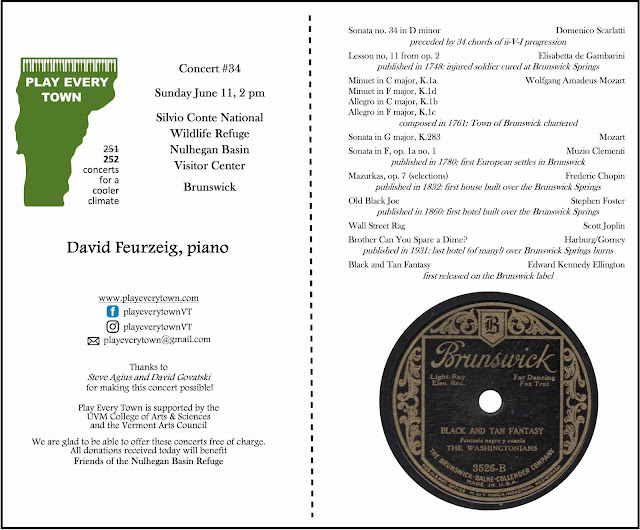
Then for my Brunswick concert, in which every piece was connected to a key date in Brunswick history (see program below), I was looking for a piece from 1748, and came across the sprightly op. 2 of Elisabetta de Gambarini, the first British women to publish a collection of original compositions. The “Lesson” op. 2 no. 11 is now my go-to opener. It’s flashier than the Beglarian pieces, though also short. So now most of my programs begin and/or close with short pieces by women, across a span of almost three centuries. 

I’m keenly aware that it would be hard to find a clearer example of tokenism. I was explicitly looking for music by women. I chose a (very) few pieces, all short and not too hard to learn. And now I take pains to include them in most of my concerts.

But as I said in my opening paraphrase: Tokenism is the deference hegemony pays to diversity. I have a ways to go, and I’m planning to work more non-male-composed music into my repertoire. In the meantime, a couple of token pieces are better than nothing.

P.S. I should make something clear. “Tokenism” frequently carries the implication that the included thing is not up to snuff, and is there merely because it represents an underrepresented category. Not the case here! The Beglarian and de Gambarini pieces kick butt.

Brunswick program


Wednesday, May 31, 2023

The Sonatas themselves

Preludes aside, learning a new Scarlatti sonata for each concert is often the largest claim on my practice time, sometimes by far—and even so the result is often less than I hope for. Well, almost every performance of anything is less than hoped for, but I mean they’re often pretty rough and not something I’m really comfortable posting online.

When I started, as I’ve said, I had never learned a single Scarlatti sonata. The commitment to learn a new one for every concert (actually two, according to my original plan) was, like the entire project, a leap of faith. By telling myself I was capable of doing this, I was willing it to be so, willing myself to be a more mindful, efficient, intentional, and musical practicer, one with more conventionally virtuosity than I felt I owned.

And it went reasonably smoothly for the first dozen or so concerts, which took place at the end of a sabbatical semester and in the summer following. But when my teaching started up again in the fall, learning the Scarlatti became an often hectic and stress-inducing element of the project. Even when all went well, I was increasingly aware that it was handicapping another quixotic ambition: to learn a lot of new repertoire, including works by contemporary Vermont composers and more music by women. I began to question my Scarlatti commitment. 

As it happened, the end of the first, busy academic year of this project coincided with a landmark in the Scarlatti cycle. Though he wrote 555 of the things, in his lifetime Scarlatti published only a single volume of 30 Sonatas (or Exercises, Essercizi, as he called them in this publication) which are nos. 1-30 in the now-standard Kirkpatrick numbering. And concert no. 30 was scheduled on the day of UVM Commencement, the endpoint of my semester obligations. Completing the 30 Essercizi, which finish with the monumental Cat’s Fugue, would bring me to a convenient milestone where I could gracefully announce a change in plans. Also, the following concerts, nos. 31 and 32, were a double-header (back-to-back concerts on the same weekend), which would add to the challenge of preparing the sonatas in time. So I told myself that I’d at least get through these iconic first thirty, then reassess.

And then...it was as if Scarlatti* saw me coming. Sonata no. 31 is a notch less virtuosic and complex than most of the sonatas in the Essercizi, while Sonata no. 32 (titled “Aria”) is slow and melodic and, at less than a full page, maybe 20% the average sonata length: easily the most sight-readable one thus far, though so gorgeous and subtle that it rewards loving preparation. It was like Domenico was apologizing for having ridden me a little too hard, and was now coaching me along: All right, ease up, come on, you got this! 

So I’m strapping back in for another round.

*Or Ralph Kirkpatrick, the harpsichordist and musicologist who assembled and numbered the most complete and scholarly edition of the sonatas. Kirkpatrick’s ordering is chronological, not arbitrary, but there is uncertainty and editorial discretion involved.

Thursday, September 1, 2022

Supererogatory Scarlatti

There are several discretionary goals I’ve set, over and above playing every town: identifying a local collaborator or composer when I can, finding a playable acoustic piano wherever possible, crafting rich post-concert write-ups, and learning a new Scarlatti sonata for every concert.

These make the project harder and logistically much more complicated. But they give the project great added value for me. Honestly, I think the Scarlatti thing is just really cool, in an inside/geeky way, even if it doesn’t have anything to do with Vermont (apart from the ii-V-I intro gag). And not just “cool”. I have discovered—as approximately zero keyboard players and aficionados will be surprised to hear—that Scarlatti was, like, wicked good.

Scarlatti’s inventiveness in the sonatas is boundless. It’s not just that there are 555 of the things. (Of course, they’re one-movement works, so the catalog is comparable to “only” about 160 3- or 4-movement Classical sonatas.) Most of them are also individually teeming with ideas. Almost every phrase has a new motive: he’s more like Mozart in this, less like the spartanly economical Haydn and Beethoven.

There is music that is fun/rewarding to listen to and music that is fun/gratifying to play. They don’t always intersect. Scarlatti’s ideas are both exciting to hear and a joy for the hands and fingers. And for the arms: he’s big on extreme jumps and dramatic hand-crossings.

He also sounds like a beautiful person. Here’s his preface to the publication of the first 30 keyboard sonatas:

Reader, Whether you be Dilettante or Professor, in these Compositions do not expect any profound Learning, but rather an ingenious Jesting with Art, to accommodate you with the Mastery of the Harpsichord. Neither self-interest, nor ambition led me to publish them, but obedience. perhaps they may please you, in which case I may more willingly obey further commands to gratify you in a simpler and more varied style. Be therefore kind rather than critical, and your pleasure will be greater. To understand the disposition of the hands, be advised that the right is indicated with a D, and the left with an M. Live happily.

I realize this preamble belongs to a type—the self-abnegating sucking up to potential patrons—but still...“Be therefore kind rather than critical, and your pleasure will be greater...Live happily.” want to hang with that guy! And I feel lucky that in a way, we get to.


Saturday, May 7, 2022

Out with the old

Last night was the launch concert. After all the non-music-related preparation of the past couple of months, it felt good to get to it. 

The program was half old, half new to me. The Beethoven, Tchaikovsky, Brahms, and two Scarlatti sonatas were first performances. The first half of the concert, my Bach “Double Suite”, I had played on my first-ever UVM concert and a few times before and after. (Here I am playing it on digital piano at a 2010 conference in Paris.) It’s virtuosic but familiar. I thought that programming it would give me some breathing room, given how preoccupied I knew I would be with project setup logistics, and function as a “safe” foundation to ground me from any anxiety about performing the new repertoire.

But the result was the exact opposite. I had more memory lapses and other extended glitches in the first half than at any concert over the past 30 years. I actually had to restart the Partita’s Courante after a false start. That can be ascribed largely to a special circumstance: I had just taken a brief unrehearsed speaking break to talk about Bach’s famous 280-mile walk (each way) from Arnstadt to Lübeck, to make a point about the dubious “necessity” of rapid long-distance travel to advance musical culture (and Bach didn’t even have the internet). My loss of focus came partly from jumping in after an unscripted chat, and partly from the anxiety of “coming out” in public, in person, as an evangelist for non-flying. Still, whatever the extenuating circumstances, overall the first half came closer than ever to validating performance anxieties which my rational brain had been telling me were phantasmagoric bugaboos.

And then, in the second half, with all the new rep, I was in the groove. I was able to let myself be in the moment more than I’ve been able to for any longish solo performance stretch in recent memory. (Being in the moment is the only way to fully realize one’s musicality, but can be scary because letting go of intention and forethought opens up the possibility of going completely off the rails.) It’s like skiing (also a challenge for me): paradoxically, the way to real control is to let go, to trust your body and gravity and send it.

From this experience, I can choose between two takeaways:

  1. Yup, your impostor fears are grounded! You really don’t know what you’re doing. Sorry!
  2. You’re on your game when playing music you’re most recently excited about and invested in. Keep on learning lots of new music!

Since I’ve committed to another 251 concerts over the next 4.5 years, I think I’ll go with Door #2.

P.S. All the above notwithstanding, the crowd was warm and appreciative, even of the first half. My favorite comment on this eclectic program: “When you have that, who needs Spotify?”

P.P.S. For another take on this concert, including a remarkably positive take on memory lapses, here is my wife’s write-up (guaranteed 100% unbiased).


Wednesday, May 4, 2022

Omnia mutantur, nihil interit

Essex Junction, until now a village within the town of Essex,* just voted to become Vermont’s tenth city. On July 1, 2022, it will legally separate from the Town of Essex and bring the number of recognized Vermont municipalities to 252. 

As for my cute little scheme to introduce each Scarlatti sonata with II-V-I progressions? Unfortunately, the “II-V-II” progression is not much of a thing. But the 251 Club says they’re not going to change their name, so I guess I can stick with my harmonic plan too.

The citification of Essex Junction also means Vermont’s municipalities tally will go from a prime to a run-of-the-mill even number. One consolation for us numerology geeks: including the four unincorporated gores and grants (not part of the usual tally) will now bring the total to 256, which is a power of 2. I’ve been wondering anyway if I ought to play these places (Averys Gore, Buels Gore, Warrens Gore, Warners Grant). If not, there will be white patches forever remaining on my map, so maybe that’s what I’ll do. But right now, with zero concerts yet played, this is definitely a “worry later” problem.

*In Vermont, “towns” are large-ish areas defined by boundaries that were mostly set arbitrarily by distant power brokers in New Hampshire or New York, usually long before there was much European settlement within those borders. “Villages” are clustered settlements within towns: the places you’ll probably find a church and maybe a general store, town hall, railway station (as in Essex Junction) etc.. Towns can have multiple villages. Villages can be incorporated or unincorporated, but in either case they are still a part of their surrounding town and are not counted in the tally of Vermont’s 251 (soon 252) distinct municipalities.  

Wednesday, April 13, 2022

Repertoire, Installment 2: Scarlatti post 2 (of 2)

Yesterday I wrote that on concert number n, I will play the nth Scarlatti sonata. Astute readers will have noted that this does nothing to make each concert specific to its place, which was my goal. But actually I’m going to play two Scarlattis in each program: one for the ordinal number of the concert in my state tour, and one corresponding to the town’s 2020 population rank. [note: see update 2, below](Burlington, with 44,743 residents, is no. 1; Lewis is no. 251, with 2 residents—that’s two with a “t” [see update 3, below].)

And in a nod to the number 251, I’ll precede each sonata with a brief jazz improvisation on the so-called II-V-I harmonic progression. This progression consists of the chord built on the second note of the scale, followed by the chord built on the fifth, followed by chord built on the scale’s key note. It is far and above the most common progression in jazz standards; playing II-V-I’s is a core practice ritual for jazz musicians. And despite the contrast in musical styles, it’s very much in keeping with Baroque musical practice to combine improvisation with carefully worked-out written compositions, a practice which is mostly defunct in the world of classical concertizing (though it’s slowly coming back).

For the first concert, these intros will consist of just a single three-chord II-V-I progression. For the second concert, I’ll do two II-V-I cycles, three in the third, and so on, up to 251 II-V-I’s in the final concert. Maybe. Like a lot about this project, plans may evolve.

It turns out I’m not the first to think of the jazz-Vermont 251 connection. My colleague, the indispensable Vermont jazz pianist Tom Cleary, has a wonderful II-V-I blog post in which he muses on the connections between the journey of the musician and that of the traveler looking to visit all of Vermont’s 251 towns.

UPDATE

In April 2022, Essex Junction voted to become Vermont’s tenth city, separating it from the Town of Essex and bringing the number of recognized Vermont municipalities to 252. I have a post about this here.

UPDATE 2

That bit about learning two Scarlattis for each concert? That lasted exactly two concerts. Now I’m playing just one, the nth Scarlatti sonata on Concert n. (One nice thing about a project with so many ambitious components is that I can pare them down and still have something left.)

UPDATE 3

Actually, Lewis, whose land is mostly wildlife refuge with the balance belonging to a timber company, pretty clearly has zero residents. The 2020 Census number reckoning of 2 must be an artifact of differential privacy.


Tuesday, April 12, 2022

Repertoire, Installment 1: Scarlatti post 1 (of 2)

From the earliest woolgathering stage of this project I’ve been pondering repertoire. How much should I try to make the programs Vermonty in general? And how can each concert be specific to its particular location? (At least in some small way; I’m not planning to prepare 251 completely different programs.) 

I’m still thinking about both those things, but I’ve come up with some ideas. This is one of the more abstract and geeky ones:

Like a lot of composers, I get excited about numerology. (J. S. Bach was particularly big on it.) So for the first concert, I’m playing a lot of firsts: Beethoven’s first sonata, Bach’s first published suite (it’s actually marked Opus 1, though Bach was 46 at the time; composers did not publish much in those days), and Domenico Scarlatti’s first keyboard sonata.

Scarlatti was a contemporary of Bach (born the same year) and, like Bach, a keyboard virtuoso and insanely prolific composer. He wrote 555 mostly single-movement keyboard sonatas. That’s important here, because I had come up with the notion of playing the nth piece of some kind on the nth concert of this project. And there are just not a lot of sets with 251 or more members of anything decent for keyboard. 

So, unless and until I give up this obsessive part of an already obsessive project, I’m going to be learning almost half the Scarlatti sonatas across a few years. If that sounds ambitious: the great harpsichordist and general bad boy Scott Ross, in what is still considered the definitive recording, put all 555 sonatas on disc (35 CDs, to be exact) in just eighteen months in the mid-1980s. And he was already suffering the effects of AIDS, which would take him less than four years later.

A funny thing is that, unlike virtually anyone who is even sort of a concert pianist, I have never prepared or performed a Scarlatti sonata before.

La Melanconia, or, My Project in 50 Words*

There is only one Play Every Town concert this April because I took on several non-PET engagements for a change.  One was the performance of...