Showing posts with label civics. Show all posts

Friday, May 23, 2025

It takes more than a village

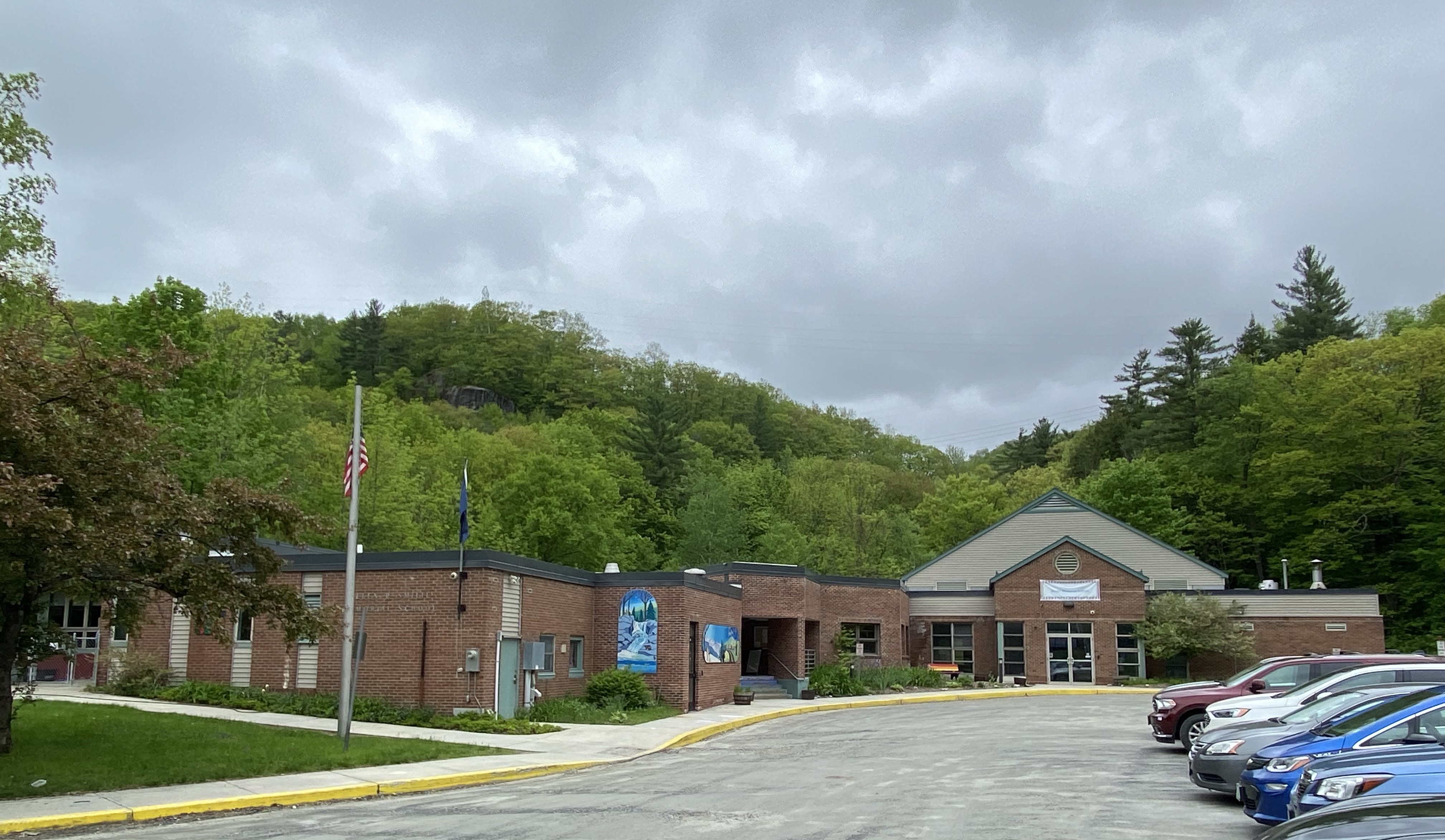
Yesterday I visited the Smilie Memorial School in Bolton to plan our upcoming concert there…my first-ever playground dedication gig.

It was a delight as my meeting with principal Derek Howard and music teacher Heather Schoppmann morphed into a spur of the moment invitation to join that morning’s rehearsals to accompany the 1st-2nd and 3rd-4th grade choruses, whose performances on June 6 will tick the “local collaborator” box on the program. Here is one of Vermont’s many wonderful, precious, obviously beloved small local elementary schools, now under intense pressures to consolidate due to declining enrollments and mandates that did not exist decades ago to serve a more diverse range of learners. 

The visit occurred the same day the US House passed a budget that slashes spending for everything but the military, which will multiply the already almost unbearable stress on Vermont’s schools. It includes massive cuts to healthcare, where costs are spiraling out of control even faster in Vermont than elsewhere. That’s because we’re an old, aging, and rural state, the very same things that account for shrinking local school enrollments.

The Smilie School’s unusual history speaks to the issues of local sufficiency, private aid, and public support. 

Due to the narrow bottleneck valley of its central village, Bolton suffered proportionally more than any other town in the Great Flood of 1927. Among many losses of life and property, the Pinneo Flats schoolhouse, once abandoned but fully rebuilt just the year before the flood, was completely washed away. 

The school became both an example and a symbol of the larger devastation. A statewide collection was taken; children all over Vermont contributed their pennies, philanthropic organizations organized donations, and Bolton daughter Ellen Pinneo Smilie gave $1000. Donations came from beyond Vermont’ s borders even—from all over the country and as far as France.

A model new school was built on higher ground. The Burlington Free Press editorialized: “We are glad this Memorial School was not created by one beneficient giver. That would have robbed a host of boys and girls of the abiding joy that will ever be there as they visit or drive past the structure and realize they had a part in this fine memorial.”

But Vermont was the longstanding most Republican state in the nation, without a single Democratic governor or US representative or senator until 1958. The New Deal and what it represented—the widespread socialization of responsibility and resources—would turn out to be unpopular in Vermont, the only state that never went for FDR. In that spirit, according to Deborah Pickman Clifford and Nicholas Rowland

To perpetrate the myth that resilient Vermont could do without government help in the wake of the 1927 flood, no mention was made of the $300 the town contributed. Nor [of] the $1,000 given by Emilie Pinneo Smilie.

So is a society that supports a decent education system and other human services without “the government” a “myth”? 

We’re about to find out.


Monday, October 2, 2023

Ferrisburgh writeup

 ...is posted.

Ferrisburgh was my first of Vermont’s seven “burgs”, and is one of the three that has resolutely held on the to final “h” in spite of the push in the 1890s from the U.S. Board on Geographic Names to drop it. 

And at the end of the month I’ll play Starksboro, my first “boro”. To my knowledge no Vermont town has persisted in resisting the Board on Geographic Names to the point of retaining the three extra letters in “borough”—though if what George R. Stewart wrote in his 1945 classic Names on the Land is on the mark, those letters didn’t go down without a fight:

Vermonter or Missourian alike might not care a penful of ink between ‑borough or ‑boro. In fact, as a practical man, he might even prefer ‑boro. But if anyone told him he must use ‑boro, he was likely to invoke all the shades of the Founding Fathers in asserting his inalienable right to ‑borough.

In addition to accompanying resident soprano Helen Lyons, I yielded the bench to Ferrisburgh native David Oliveira to play two of his solo piano Nocturnes. This atypical “collaboration” made the grade because David was my composition student at UVM, and I’d even given some feedback on one of these nocturnes. I had originally thought to play them myself, but as the concert approached I knew he’d do a much better job. It’s not just that during the teaching semester I find myself pressed for time even with just 2-3 concerts a month; David’s rendition of his own music is amazingly sensitive and expressive.

Thursday, August 17, 2023

Landgrove: Gore-land

Concerts no. 37 and 38 were both in towns with connections to two of Vermont’s remaining gores, in an interesting reciprocal way, as I discussed here.

Extending the coincidence, concert no. 39 was in an ex-gore. Almost all Vermont gores were eventually annexed to a nearby town; Landgrove is one of the few exceptions, a gore that became its own town. (I think the only other one is Stannard.) 

Apparently the first settler family, the Utleys, thought they were in the town of Peru (then called Bromley). After living there a few years, it became clear they were actually in a gore between Bromley, Weston, and Londonderry. Rather than joining up with Bromley, Capt. William Utley and a few others who had settled in the area petitioned the Vermont legislature in 1780 to form their own miniature town. 

I assume this had something to do with not wanting to pay Bromley taxes, or maybe some more specific beef with Bromley; in any event the precise town line was contested for some time, with the ensuing lawsuits not settled until 1835 by the Legislature.

Interestingly, there is no record of the origin of the town name. It is generally assumed to be a “made” name: a land of groves. But given the long boundary dispute, I like to think the name is an anagram of “Land” [i.e. self-governing area] “v. Gore”.


Monday, July 10, 2023

Some gorey details

By chance, I’m playing two towns in a row at the end of July which have historical connections to two of Vermont’s four remaining gores: concert no. 37 in Warren and concert no. 38 in Coventry. In a further coincidence, each town is oddly distant from its associated gore, but very close to the gore belonging to the other.

You, dear reader, are likely by now asking “what is a gore?” I’ve mentioned them in two earlier posts but without explanation. In the broadest definition, a gore is any “irregular parcel of land, as small as a triangle of median in a street intersection or as large as an unincorporated area the size of a township.” (Wikipedia) In New England, a gore is more specifically a piece of land that has never been incorporated as a town, and so has limited local government, if any, and often few or no inhabitants. (A once established town that is depopulated and stripped of its municipal status is called something else, an “unincorporated town”, at least in Vermont, which has two: Somerset, pop. 6, and Glastenbury, pop. 9.) Of the New England states, only Maine and Vermont have remaining gores. Typically, gores are “leftovers” resulting from incomplete, erroneous, or conflicting surveys, but they can also be created intentionally. 

On July 21 I’ll be playing in the United Church of Warren. As most of Vermont was being divided into towns in the late 1700s, the aim was to create roughly 6-mile-square parcels. When the town of Warren was chartered in 1789, the main tract of land intended for it, in the Mad River valley, was on the small side. To make up for this, a roughly 11 square mile gore was added—about 100 miles northeast. The gore has always been treated as distinct from the town of Warren proper, and no one was recorded living there until the 1970s. At some point it was officially separated. It’s referred to variously as Warren Gore, Warrens Gore, and Warren’s Gore.

Meanwhile in 1780, Major Elias Buel, a veteran of the Revolutionary War originally from Coventry, Connecticut, put together a group that petitioned the Vermont Legislature for a grant in the area south of Middlebury. But there was a misunderstanding about the surveying (which is odd, because one of the Buel group was Ira Allen, the Surveyor General of Vermont) and it turned out there was no longer enough unincorporated land there for a town. So a few years later the Legislature let them convert their claim into a “flying grant”, basically permission to go hunting around the state for enough acreage to make up a town. They ended up cobbling together three parcels: the main one, which they called Coventry; a gore called the Coventry Leg, which was eventually annexed to the town of Newport, and a second gore far to the south, a little triangle of land that looks like it could be the dot under the question mark of the town of Huntington (where I live). Known as Huntington Gore, it now became Buel’s Gore, changed to Buels Gore when the US Postal Service told everybody to get rid of their apostrophes.


If all this seems a bit geographically insane, it helps to know that the chartering of towns was a largely financial and speculative business. Governors and legislators sat in rooms sometimes hundreds of miles away and, often to curry favor or pay political debts, granted to speculators the rights to land they might never have seen, about which they may have known very little, and where they often had no intention of settling. Sometimes the grantees planned to establish farms or lumbering operations, but often they were just looking to make a quick buck by selling their holdings. Adding to the general chaos, prior to the establishment of the Vermont Republic in 1777 there was a race between the governments of New York and New Hampshire to plant towns as quickly as possible to bolster their competing claims to the Vermont lands.

More on Vermont’s gores: 
Mark Bushnell, 
Then Again: A use for Vermont’s leftover bits and pieces
Good Seven Days article on Buels Gore: Ruth Horowitz, Gore Values

Saturday, July 8, 2023

Number theory

I like 251. It’s prime, which is a pretty rare distinction at this magnitude (there are only 16 primes between 201-300). And it was the foundation of my Scarlatti ii-V-I intro pun

But when the village of Essex Junction calved off from Essex Town, my number went to 252. Not prime, but it has some redeeming features. It’s 7 x 36, and 6 x 42, Coincidentally, as I write this, I’m exactly 1/7 of the way through (36 completed concerts) while 6 more are fully confirmed, meaning exactly 1/6 of all towns (42) have been played or scheduled. And 7 x 36 also means that at an average of exactly 3 concerts a month, the project will last exactly 7 years, which is my current goal. Which is of course subject to change, like everything about the project. Like everything, period. If the destabilization of the climate continues to accelerate as it has been, it’s not obvious we’ll have a well-organized society six years from now.

However, 252 is not my actual number. I plan to play the four gores and grants as well, as I suggested at the outset of the project. The gores and grants are not, and have never been, officially organized municipalities, so they were never part of the official tally of 251 or 252. But I’m using a gradually filling-in map as the trademark representation of the project's progress. If I don’t play the gores and grants, there will be residual white space, and the project will look forever incomplete.

So my true target number is 256. Also not prime, but a power of 2, 28, which is nice. 

As the gores and grants are not proper towns, I don’t have to do proper concerts there. Like: I don’t have to play a new, ordinally matched Scarlatti sonata, I don’t have to have a local collaborator, I don’t have to play a full concert of an hour or more, and I don’t necessarily have to play the piano. Also, to avoid confusion, I’ll give them ancillary numerical designations, like “51a” for a gore performance that follows the 51st regular concert.

Again, as with everything about this project, all professed schemes are subject to change, with details coming into focus as the events approach. 

Monday, March 20, 2023

Ludlow write-up

 ...is here. It includes observations about the United Church’s remarkable Shingle Style building, longtime Ludlow resident Ida May Fuller (recipient of the first-ever Social Security check, who eventually received 925 times her total contributions), and, via Don Quixote, the relation between activism and mental health. 

When I told the bit about Social Security to my physical therapist, she said “...and that’s why there will be nothing left for us.” So, first of all, no; Social Security is pretty secure, and could be completely paid for decades into the future with just modest changes like raising the income cap on contributions. 

But more importantly, why should the Social Security program have to break even? Do we expect federal highways to pay for themselves, without general revenue funds? What about the Department of Defense? 

The linkage of Social Security benefits to a payroll tax was, as much as anything, a political move on the part of President Roosevelt. It was a way to overcome resistance to the idea of a social safety net by making the benefit into something that each worker has to at least partly earn by paying into the system. 

The link is real, both in the sense that tons of money flows into the federal government through payroll taxes, and in that individual benefits are tied to the length and amount of individual contributions. But that does not change the facts that the linkage has its origins in overcoming American resistance to the idea of unearned government aid, and that there is no reason the program should be expected to cover 100% of its expenses any more than any other public service has to.

Where was I? Oh yes, the write-up has pictures, descriptions, and clips of the concert, also, too.

Sunday, March 19, 2023

Mega-media and monopolies

Following up on my last post. Of course I could solve the context problem by using another platform to host my videos, one that lets me embed them without making them otherwise publicly findable. But in the present moment, if a video is not on YouTube or Vimeo or the like, it feels like it’s semi-hidden. Which I guess is what I’m after, but it feels at cross purposes to the goal of increasing overall awareness of the project.

Likewise I’m not a big Facebook fan, but for now it remains a go-to for promotion of all kinds, and keeping a project off the platform is self-limiting. 

There can be positive aspects to monopolies and monoliths, like the expectation that you can check just one or two major clearinghouses to find information about an event, or that you can share files in universally comprehensible formats (DOCX, PDF). When the organizations that regulate these quasi-monopolies are well-governed, distributed, and not for profit, like Wikipedia or the MIDI Manufacturers Association, the results are often excellent. When they’re private and for profit, results are often at least kludgy (Word) and not infrequently dangerous and malign (insert social media platform of your choice). 

Thursday, June 23, 2022

Point of order: towns, villages, gores, and grants

This Saturday’s concert in Jeffersonville prompts me to revisit the question of community place names.Someone asked me “Where are you going to play in Moscow?”. I say “Nowhere—didn’t you hear I stopped flying?” Haha, I kid, I know they meant Moscow, Vermont. But the answer is still “nowhere”, at least not for purposes of fulfilling this project mission, because Moscow  is not a town but a village in the town of Stowe, whereas I will most likely play in Stowe (village), which is…also a village in Stowe. I get similar questions about other villages. As I wrote in a post back in May:

In Vermont, “towns” are large-ish areas defined by boundaries that were mostly set arbitrarily by distant power brokers in New Hampshire or New York, usually long before there was much European settlement within those borders. “Villages” are clustered settlements within towns: the places you’ll probably find a church and maybe a general store, town hall, railway station (as in Essex Junction) etc. Towns can have multiple villages. Villages can be incorporated or unincorporated, but in either case they are still a part of their surrounding town and are not counted in the tally of Vermont’s 251 (soon 252) distinct municipalities.  

This project is Play Every Town (and city), not Play Every Village. It is understandably confusing. Many towns, like Stowe, have an eponymous village. Or back to this weekend’s concert, I will be playing my Cambridge performance in Jeffersonville, not in the other village in Cambridge, which is…Cambridge. 

Adding to the confusion, a few villages are located in more than one town, like the nearby village of Underhill Flats, which straddles Underhill and Jericho.

And I didn’t even trouble you with the onetime Cambridge “hamlets” of Pleasant Valley, North Cambridge, and East Cambridge. As far as I can tell, a hamlet is just a smaller village, but there is no sharp distinction between the two. Except that some villages are officially incorporated, meaning that they have at least some services and taxes, such as water or sewage, that are in addition to the services provided by the encompassing town. But even Vermont’s 35 incorporated villages (soon to be 34, I suppose, when the village of Essex Junction becomes an independent city on July 1) are not counted in the official 251 (soon 252) tally of towns and cities. Like Essex Junction, most of Vermont’s 10 (soon 11) cities came into being when large-ish villages calved off from their parent towns.

I don’t have an official Vermont village count, and I don’t think an unarguable count would be possible. But many towns have multiple villages, so I am guessing a fair tally would be around 600. Some are officially incorporated, others are Census Designated Places but not government entities, others are barely detectable historical relics from a time when a few dozen homes a few miles distant from the next village was occasion enough for another post office or general store. And since Scarlatti wrote only 455 sonatas, I can’t play in every village, as this will make clear.

Then there are a few towns without villages, because they are almost or completely without people. I’ll be playing those towns too, because they’re on The List. And as I mentioned in the May post referenced above, I’ll play the four gores and grants for an even 256, lest I leave blank spots on my concert map. More about those another time, I have to go practice.

Thursday, May 19, 2022

Ripples and resonance

The Piano Performance Places wiki spinoff idea was born because the idea resonated with other pianists. They could have been protective of the limited opportunities to play in the area, but have chosen instead to be generous in sharing information. Mostly because they are all first-rate human beings…but also because the ideas of expanding opportunities for players, increasing the musical offerings in small places, and of finding more localized ways of touring, all spoke to an existing desire.

The Play Every Town tour is showing signs of reverberating beyond my 252 performances in other ways as well. I’m planning what will be our first school concert with a former student who is now the instrumental music instructor there. I invited her and her vocal-music colleague to perform with me in a piece or two. She said good, her students know the she and her co-teacher play and sing, but their students haven’t heard them perform and it was time they should. In another town, the librarian hopes that our performance there will be a catalyst to advance dormant plans to fix up the piano and disused town hall auditorium above the library.

My project is just 252 pebbles dropped in a little pond. They’ll make their small splash, which might even ripple a ways. But those ripples will quickly subside—unless there’s resonance (lit. “sounding again”). If the pebbles drop at the right frequency, the waves will match the pond’s natural reverberance, and if that happens, the results are astonishingly powerful.

This is how I’m learning to think about individual actions to address the climate crisis. Yes, we need drastic, and drastically sudden, changes at a level that can only be effected by government policy. And because our governments have been thoroughly captured by industry, this will require a fundamental change in how we are governed: a revolution. But individual action is still important. Not because “if everyone did that, it would really add up” (there isn’t time for that; it won’t add up fast enough) but because individual actions, if they resonate, can have non-linear impacts. But only if we are vocal about them.

Tuesday, May 10, 2022

How to book 251 concerts, part 3: Tap into networks

The challenge of this project is not just finding 251 places to play, but wherever possible, places with a playable acoustic piano. To locate them, we’re tapping into various networks.

Piano technicians. The Piano Technicians Guild has a Vermont Chapter. If there’s a piano that’s being taken decent care of, one of the Guild members is probably taking care of it. The President and Secretary couple of Justin and Emily Rose kindly posted a blanket inquiry to the Guild’s listserv that has led to useful tips on where to find pianos in out-of-the-way places, or where the best pianos are in place with several to choose from. In particular, technicians know about pianos in private homes that might not otherwise be easy to discover.

Librarians. Ironically, perhaps, town libraries are a frequently where a decent piano meets a public space. (I’ll play quietly.)

Music educators. Schools often have a piano in a big room, if not an auditorium. Much of Vermont’s population is rural and aging, so most towns belong to consolidated school districts that share a high school, middle school, or even elementary school with several other towns. This gives union school music teachers a central role and bird’s-eye view of the music scene in multiple towns. So far that has proven enormously helpful in getting information about a multi-town region quickly. Also, we are aiming to include collaborations with local musicians wherever possible, and music teachers know the musically active current and past students. The same is true of many church music directors, who may serve in multiple towns, or whose churches may have congregants from a broad area.

Town Clerks. When I started thinking about this project, Freddie Hart, who coordinated the Vermont Symphony’s Project 251 in the 1980s, told me to “talk to the Town Clerks”. That makes sense: in my town of Huntington, long-time Town Clerk Heidi Racht is the person who, put simply, knows everyone and everything. (Actually, she splits the role of omniscient ombudsperson with Linda Pecor, who runs Beaudry’s, the general store.) So far, though, we haven’t reached out to Clerks. I think the fact that one can do an internet text or map search on a town together with likely prospects such as “church” or “library” or “grange” has made the Town Clerks’ living knowledge a less obviously essential starting point. 

You know, as I wrote that last sentence, it felt quite sad and contrary to the community, humanist spirit of the project. Time to close the computer and start calling Clerks!

Wednesday, May 4, 2022

Omnia mutantur, nihil interit

Essex Junction, until now a village within the town of Essex,* just voted to become Vermont’s tenth city. On July 1, 2022, it will legally separate from the Town of Essex and bring the number of recognized Vermont municipalities to 252. 

As for my cute little scheme to introduce each Scarlatti sonata with II-V-I progressions? Unfortunately, the “II-V-II” progression is not much of a thing. But the 251 Club says they’re not going to change their name, so I guess I can stick with my harmonic plan too.

The citification of Essex Junction also means Vermont’s municipalities tally will go from a prime to a run-of-the-mill even number. One consolation for us numerology geeks: including the four unincorporated gores and grants (not part of the usual tally) will now bring the total to 256, which is a power of 2. I’ve been wondering anyway if I ought to play these places (Averys Gore, Buels Gore, Warrens Gore, Warners Grant). If not, there will be white patches forever remaining on my map, so maybe that’s what I’ll do. But right now, with zero concerts yet played, this is definitely a “worry later” problem.

*In Vermont, “towns” are large-ish areas defined by boundaries that were mostly set arbitrarily by distant power brokers in New Hampshire or New York, usually long before there was much European settlement within those borders. “Villages” are clustered settlements within towns: the places you’ll probably find a church and maybe a general store, town hall, railway station (as in Essex Junction) etc.. Towns can have multiple villages. Villages can be incorporated or unincorporated, but in either case they are still a part of their surrounding town and are not counted in the tally of Vermont’s 251 (soon 252) distinct municipalities.  

La Melanconia, or, My Project in 50 Words*

There is only one Play Every Town concert this April because I took on several non-PET engagements for a change.  One was the performance of...