Friday, May 1, 2026

More scouting notes from the road

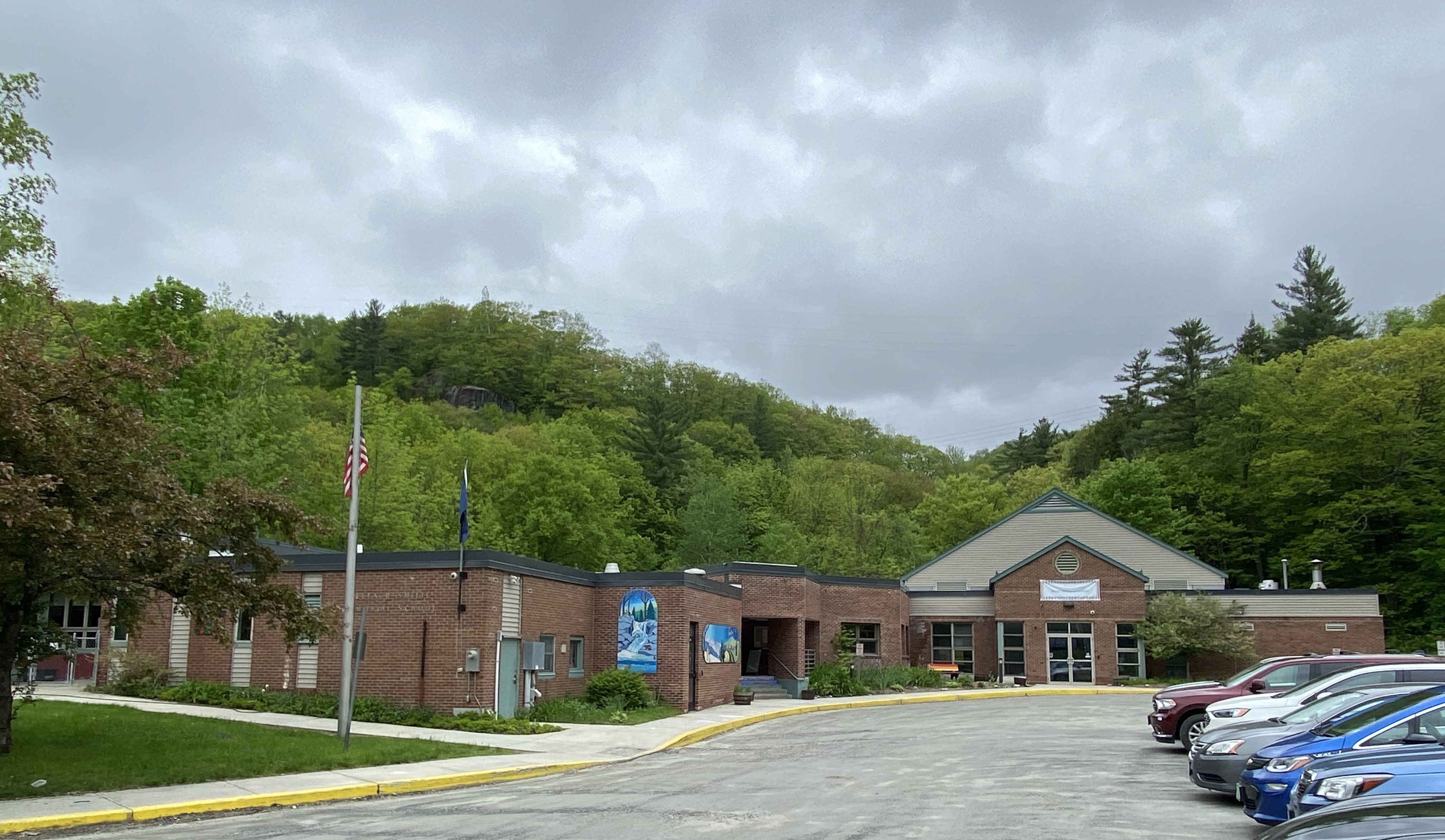
Yesterday on my way home from an accordion lesson in Strafford I detoured through the town of Washington to scout for a piano. I’d had an invitation to play at the Unitarian Church, but unfortunately they had no piano, while the other church in the village had a fairly restrictive statement of beliefs on their website which made me think it might not be the ideal PET venue. So I stopped by the Washington Village Elementary School.

Jessica at the front desk buzzed me in. I explained my project to her and aksed if the school had a real piano. She replied “You just walked past it.”

Yes I had, and there it was, a Samick studio upright in the covered walkway outside (!) just before the main entrance—even as I was looking for a piano, I did not register one right next to me in such an unlikely place. Jessica told me “They were going to get rid of it, but I said no, put it out there, the kids will use it. And they love banging around on it!” 

I went back out with appropriately low expectations for an outdoor piano in Vermont’s harsh and variable climate. But the real enemy of pianos is the swing in relative humidity, which can be less extreme outdoors than in a heated environment, and the piano was in surprisingly OK tune. Everything worked except for three keys, but they were pretty important ones, not at the extreme registers as is often the case but in the middle of the keyboard. I tried to open the lid to see what was the matter, but it was screwed shut.

I buzzed back in and said to Jessica I said “I see that the top is screwed shut.” I was waiting to hear something like "Yeah. The kids were messing around on the inside and we didn’t want them to break more stuff.” But Jessica said “Yeah. Someone’s head got stuck inside, so we screwed it shut. Kids!”

I feel like I need to start wearing a body cam, because there's no reenacting these first encounters for video. The photo here will have to do. 

I am now working to schedule my Washington concert at the school.


Sunday, April 12, 2026

Where’s Waldo, or, A Day in the Life of a Rural Piano Scout

Most concerts originate with an invitation from the venue, prompted by the general publicity around the project or audience word of mouth from prior performances. But I also do a fair amount of scouting, particularly in smaller towns, to identify locations with working pianos and, in essence, invite them to invite me. This may start with internet sleuthing for likely locations (church, town hall, Grange, etc.) and maybe a call to the Town Clerk or other contacts people may have tipped me to, but eventually many hours of on-the-road legwork too, going from village to village all over the state—some of them really ghost villages, yet often with a functional building and ancient but functional piano. This “Where’s Waldo” hunt for small-town piano-appointed public spaces is an ongoing and fascinatingly evocative facet of the project.

Last Thursday, I found myself in central Vermont with time on my hands and decided to tackle the towns of Pittsfield and Chittenden, for which I had no leads yet. In Pittsfield (pop. 504) I determined via Google maps that there was a federated church, a town hall and a library, all in the one village within spitting distance of one another. There was no one in the locked church. As I have done countless times, I peered into the windows along the sides, but they were shaded and there was no view. I wandered over to the Roger Clark Memorial  library, above the town clerk’s office, and asked Lisa, the librarian, if there was a piano in the adjacent Town Hall. She though not, but a trio of women who were planning the next book club meeting thought there was. Two of them, Doreen and Katrina, were on their way there to see if the library wifi signal would reach that far, as they had recently acquired a projector and were preparing to inaugurate a town movie series there. So I tagged along. The door code that the librarian had given them wouldn’t work for us, but Randy, the assistant town clerk, on his way back from the post office, used his own code and got us in.

There was indeed a piano—a Hughes & Son, serial no. 5084, manufactured for the Wade company in 1908, in Maine (the first Maine piano I’ve ever encountered). A grand old upright from the “golden era” of piano manufacture, when there were literally thousands of manufacturers in the U.S. alone. Someone at the factory had taken the trouble to hand-pant some arabesque filigree on the internal plate. The plate also had a record of past tunings, the most recent in 1985. Which, judging from its current sour intonation, may well have been the last time it was tuned. The 1985 tuner had noted that even after that tuning, the pitch was “1/2” (presumably a half-step, or maybe half of a half-step) low, no doubt because it had started so far below pitch that it wasn’t advisable to bring it up all the way in one tuning.

In other words, it was wicked out of tune. So far so, in fact, that some of the unisons (multiple strings tuned to the same note) sounded not like even out-of-tune unisons but rather a full half-step apart. I had to open the lid and check that the hammers were not just out of alignment and striking adjacent strings by mistake.

Even so, the old thing had life in it. Doreen was kind enough to take a couple of short videos of some Joplin and some James P. Johnson—music that is fast and reliant on rhythm for its interest while also harmonically relatively simple, and thus can come across even through deeply troubled intonation. And Doreen and Katrina volunteered on the spot to help facilitate and eventual Town Hall performance in Pittsfield. Assuming the pins and pin black are not faulty, and the strings not too badly rusted, it should be tunable. (The project never collects a performance fee or any other compensation, but we do ask that the piano be tuned. If this is a hardship, we can occasionally use some of our modest grant funds and patron donations to cover tuning costs.)

It’s always possible that the situation will be more favorable at the church—I’ll follow up there with calls or emails. But as most of the project concerts are in churches (to paraphrase Willie Sutton “because that’s where the pianos are”), I do enjoy scheduling Grange Halls, Town Halls, schools, and libraries for variety when I can.

This little diary covered half of my 6-hour piano scouting day in Pittsfield and Chittenden (where I also found a likely venue and several helpful friendly potential organizers). Or in other words, less than 1% of the 252 towns total, or just over 1% of towns remaining to be played. (Though I also squeezed in a visit to Ellis Music in Bethel, where I made contact with Tony who it looks will be able to identify locations and local collaborators for several of the adjoining towns.) As the saying goes: Magna patria, vita brevis.


“Jungle Drums” by James P. Johnson


Tuesday, March 17, 2026

Newfane writeup

Not to jinx it, but maybe I’m finally getting around to the concert writeup catch-up I’ve been professing I’m about to do since about forever. 

The Newfane writeup includes background on resident collaborator Dan DeWalt’s central role in the 2006 campaign to pass local resolutions to impeach President Bush for attacking Iraq under false pretenses, against the grim background of the present imminent illegal attack on Iraq. All so directly tied to energy and climate. There are glimmers of hope on the renewable energy front, but on top of all the other horrors of the current warmongering, it is crushing how the U.S. regime is repeating the mistake Reagan made with his unilateral surrender in the just war Jimmy Carter had declared on fossil fuel dependency. 

Ah well. It was a lovely concert anyway, with a warm audience and handsome space and nice piano. 

Friday, March 13, 2026

Peacham Writeup

I actually posted this a couple weeks ago, forgot to record it here. I was very happy to make me debut as an accompanist for musical saw, sawed elegantly by Michael Kennedy of neighboring West Barnet, and I think the video of our “Over the Rainbow” rendition came out nicely. I was also super pleased to learn that Peacham was probably named for the character of Polly Peachum from the Beggar’s Opera, and that we were able to arrange a performance of the romantic songs from that show in time for Valentine’s Day.

Lavinia Fenton as Polly Peachum


Wednesday, February 18, 2026

Cornwall writeup

 A new record here: coming up on three years between concert date and writeup. (Finally getting around this sabbatical semester to what I hope will be a steady catch-up on undocumented past concerts, now numbering over 50.) I was afraid I wouldn’t be able to remember anything, but it worked out fine. The recording and photos helped a lot.

Sadly but aptly, the writeup also features a memorial to one of the organizers, Cornwall Congregational’s organist Charles Callahan, who passed just months after this concert, on Christmas Day 2023.

As I mentioned briefly there, this was one of a surprisingly large number of PET concerts where our event is the first one in a newly dedicated or renovated community space, or on a newly acquired or newly refurbished instrument. That will be its own blog post someday.


Saturday, August 23, 2025

The eternal awkwardness of the minstrelsy legacy, or, opportunity knocks

I haven’t posted here in ages. I have a backlog of topics, but I’ve been overwhelmed by other aspects of the project. And by the larger things happening the last 10 months, which make it feel small and challenging to post about the trials and triumphs of my little endeavor. But it’s time. Here’s a bagatelle that’s maybe obliquely timely in this moment when many of our leaders are dedicating themselves to making racism great again.

I was telling my son about one of the town-themed pieces for my Norwich concert. Norwich is home to the King Arthur Baking Company. So I found a piece from 1896, the year the brand was launched: the aptly but cringily titled “Remus Takes the Cake”, a turn-of-the-century cakewalk, complete with a thick-lipped caricature on the sheet music cover. 

My son said “well that’s not at all problematic”. 

Now, cakewalk has a troubling resonance, above all here in Vermont. But music professor that I am, I had to expound on its complex cultural connotations. The dance originated on Southern plantations, where enslaved Africans saw the whites opening their soirees with a “grand march” and were inspired to parody the very proper and very simple dance of their oppressors. Dressed in the finest clothes they could manage, they mimicked the two-by-two parade-style dance, mocking the basic and formal steps of the white folks while simultaneously jazzing them up with virtuosic flourishes. And they turned it into a competition, with the winner of course “taking the cake”.

Before long the white folks witnessed these satires, and rather than take offense, they sponsored and then imitated the slaves’ spoof of their own dance, in turn caricaturing the ragtag “formal” clothing and (notoriously) the stereotypical African physiognomy as well by making themselves up in blackface. The reflections don’t stop there: when the minstrel show came into being in the 19th century, traveling Black performers bizarrely adopted one aspect of the white owners’ imitation of their slaves’ satire of their masters’ formal dance: they performed in blackface themselves. And this is the iteration that white fraternity and sorority students were emulating when they performed in UVM’s annual Kake Walk, one of the most lavish, elaborate, and long-lasting instances of the tradition, which continued—in blackface—under increasing protest until finally abandoned in 1970.

So that, I concluded, is the nuanced history of the genre, one of many instances where cultural exchange, no matter how involuntary, brutal, and violent, has borne rich and often wonderful fruit; whatever its origins and its latter connotations, a cakewalk is not in and of itself undilutedly racist.

“And a Jewish guy playing a cakewalk in 2025? How do you fit in?”

Dude—I replied—there’s a freaking cakewalk with cake in the title written the year King Arthur Flour was launched. I’m giving a concert in the town where King Arthur is based. I’m gonna play it!

“Ah, a pragmatist.”


Friday, May 23, 2025

It takes more than a village

Yesterday I visited the Smilie Memorial School in Bolton to plan our upcoming concert there…my first-ever playground dedication gig.

It was a delight as my meeting with principal Derek Howard and music teacher Heather Schoppmann morphed into a spur of the moment invitation to join that morning’s rehearsals to accompany the 1st-2nd and 3rd-4th grade choruses, whose performances on June 6 will tick the “local collaborator” box on the program. Here is one of Vermont’s many wonderful, precious, obviously beloved small local elementary schools, now under intense pressures to consolidate due to declining enrollments and mandates that did not exist decades ago to serve a more diverse range of learners. 

The visit occurred the same day the US House passed a budget that slashes spending for everything but the military, which will multiply the already almost unbearable stress on Vermont’s schools. It includes massive cuts to healthcare, where costs are spiraling out of control even faster in Vermont than elsewhere. That’s because we’re an old, aging, and rural state, the very same things that account for shrinking local school enrollments.

The Smilie School’s unusual history speaks to the issues of local sufficiency, private aid, and public support. 

Due to the narrow bottleneck valley of its central village, Bolton suffered proportionally more than any other town in the Great Flood of 1927. Among many losses of life and property, the Pinneo Flats schoolhouse, once abandoned but fully rebuilt just the year before the flood, was completely washed away. 

The school became both an example and a symbol of the larger devastation. A statewide collection was taken; children all over Vermont contributed their pennies, philanthropic organizations organized donations, and Bolton daughter Ellen Pinneo Smilie gave $1000. Donations came from beyond Vermont’ s borders even—from all over the country and as far as France.

A model new school was built on higher ground. The Burlington Free Press editorialized: “We are glad this Memorial School was not created by one beneficient giver. That would have robbed a host of boys and girls of the abiding joy that will ever be there as they visit or drive past the structure and realize they had a part in this fine memorial.”

But Vermont was the longstanding most Republican state in the nation, without a single Democratic governor or US representative or senator until 1958. The New Deal and what it represented—the widespread socialization of responsibility and resources—would turn out to be unpopular in Vermont, the only state that never went for FDR. In that spirit, according to Deborah Pickman Clifford and Nicholas Rowland: 

To perpetrate the myth that resilient Vermont could do without government help in the wake of the 1927 flood, no mention was made of the $300 the town contributed. Nor [of] the $1,000 given by Emilie Pinneo Smilie.

So is a society that supports a decent education system and other human services without “the government” a “myth”? 

We’re about to find out.


Friday, April 25, 2025

How to schedule 252 concerts, part ??

Once again I’ve fallen behind in concert scheduling. I’ve been acting chair of the UVM music program, covering for a colleague on sabbatical. And for lots of reasons, including but not limited to the lawless chaos raining down from the authoritarian regime in DC, it’s been far more work than the advertised seat-warming gig. 

But whenever I’m in any kind of low point in the project, whether it’s because of delinquent posting frequency, scheduling challenges, new repertoire overwhelm, general burnout, or whatever, some serendipitous exciting new thing pops in to pull me up.

Today a quick call led to an immediate date just a few weeks ahead. (The hardest assignment is filling in the upcoming schedule on short notice.) At a nearby elementary school, a fun thing I’ve been looking to do more of. 

The only downside to an in-school gig is that it’s probably not appropriate to make it a fundraiser and may limit the audience—thus depressing my all-important STATISTICS. (I track attendance and donation amounts, partly for purposes of grant-writing, but mostly out of obsessive competitive self-analysis…I have a draft post about this, about the seductiveness and insidiousness of quantification.) 

But the school principal on the other end of the line said they were planning a celebration to dedicate a newly redone playground. On a Friday—my project’s only convenient weekday concert slot. Could we do something in conjunction with that? Thus making it a schoolday yet also a public event. 

I was already fully cheered up. Then he mentioned that a student was hoping to sing the national anthem at the event…there’s my “local collaborator” box ticked with no further legwork.

It was just one good vibe after another from there. To top it all off, he had what I (having admittedly little clue) would call a non-posh London accent. I’m a total sucker for that inflection; it was like talking to Idris Elba.


x

Thursday, April 24, 2025

Hartland writeup & regime kidnappings

  ...a few days ago actually, here.

Another one of the serendipitous occurences I keep running into, this one poignant and somber. I’d been following the case of Mohsen Mahwdawi, who was kidnapped by ICE agents just five days earlier and is being held in violation of his first amendment rights; the protest demonstration for his upcoming court appearance in Burlington was in my calendar. But we drove down to Hartland not knowing it was home to Mohsen’s church. 

And the concert, rescheduled from a couple weeks earlier because of weather. was on the 250th anniversary of the start of the American Revolution, fought to free the colonies from a mad king restricting civil liberties (and imposing unfavorable trade policies...)

When we arrived, our sponsor, Chiho Kaneko, told us the church had just hosted a 300-person vigil where, she said, the fear was palpable. 

On the spot, we added Woody Guthrie’s classic “All You Fascists Bound to Lose” to the program. The entire audience joined in, and I think drew some courage from the music and the special solidarity that comes from singing together.

The speed and effectiveness with which the current regime has been wrecking our government and norms  is breathtaking. But the pushback is having a manifest effect.  I suspect it is not a coincidence that two of the three currently most high-profile immigration cases  are being heard in Vermont, home to just 0.2% f the US population but to 50% of the team  (Bernie and AOC) that has been barnstorming the red states with their message of resistance. If it was intentional, it will prove to be another instance of overreach. Vermont has a strong and deep tradition of independence and libertarianism. Just saying.

Sunday, March 16, 2025

Franklin writeup posted

Franklin (almost a year past) was the first of what will eventually be 13 Canadian border town concerts. As I relate in the writeup, it was once the staging area for an invasion of Canada by Irish Republican American Civil War veterans. It is thus implausibly timely for our present insane historical moment, which is the reason I bumped it to the front of the queue as I deal with the backlog of 40 or so undocumented performances. That, and so I could have it up in time for St. Patrick's Day tomorrow.

As with Williston, I got maybe carried away with the interesting context. But this is what makes the writeups fun for me. I approach them as artistic creations just as much as the programs. Maybe more so: they are like compositions, and as people sometimes say about art, a way of making experience make sense. 

And they give the project a sense of solidity and completeness. Also I have a sieve-like memory, and without the writeups, past concerts would quickly dissolve into a hallucinatory vagueness.

complete comic by Kate Beaton here


Saturday, March 15, 2025

Williston write-up posted

Here. I got maybe a bit carried away with some of the town context. But it’s a big part of what’s fun to me about the writeups and about the shape of the project as a whole. Of course, for most of the towns I know very little to start with, and not that much more even after reading and visiting. Because we lived in Williston for 5 years, and because Williston looms large in the contentious debate over development in Vermont, I had more to share.

It’s been a long time since my last writeup. Almost 6 months. I’m now about 40 behind—more than half of the 77 completed concerts, with the oldest undocumented concert almost 2 years old now. 

But my crack webmaster, UVM CS major Lindsay Hall, has designed an improved concert writeup template that allows for more flexible and easier-to-compose layout. And with each video clip I’m getting a little more fluent with Final Cut, my editing software. Clearly I need to examine how much background and detail I put into each writeup, but I’m optimistic these developments will help me get through the backlog in a few months.

It’s also been a long time since my last blog post—about 4 months. I have a lot to say, but recent events make me feel different about what’s worth saying. Also just other, non-earth-shaking life stuff has kept me extra busy. Still, a bunch of my thoughts do want to get said, so that will happen eventually.


Thursday, November 21, 2024

the bells that still can ring

(thoughts after defeat)

I never thought we’d “win” the climate fight, that we’d stave off catastrophe. It’s always been about harm reduction, trying to do what we can to so things get less worse.

That remains true if the baseline of hope, what we can reasonably imagine can be saved, just got knocked down a piece, though it’s hard to get up and keep going after a big defeat. In an interview with Norman Solomon, peace activist Fred Bronfman said:

I find it hard to have much “hope” that the species will better itself in coming decades. I have also reached a point in my self-inquiries where I came to dislike the whole notion of “hope”. If I need to have “hope” to motivate me, what will I do when I see no rational reason for hope? If I can be “hopeful”,  then I can also be “hopeless” and I do not like feeling hopeless.

When I looked more deeply at my own life, I noticed that my life was not now and never had been built around “hope”. Laos was an example. I went there, I learned to love the peasants, the bombing shocked my psyche and soul to the core, and I responded — not because I was hopeful or hopeless, but because I was alive.

We respond because we are alive.

Back to Leonard Cohen (I guess things are dark when the appeal is to Cohen)—

I’m on the side that's always lost against the side of Heaven
I’m on the side of snake-eyes tossed against the side of seven 

Time to pick up the silver captain’s bars and pin them to our shirts.

Saturday, November 9, 2024

Paralipsis, or, this is not a blog post

It feels like Nov. 5 changes everything, including the concerns of this project. So it would be weird not to post anything about it. On the other hand, I have nothing I want to say at this point, in this space. So I’m not writing a post-election post.

“Fight On” by Pedro Molina

Saturday, September 28, 2024

National News: Local Man Does Local Thing

So last week’s Wall Street Journal feature on the project has had a pretty big impact. More about that in another post. Here I just want to talk about the story’s karmic genesis. 

I’ve courted press coverage since before the project launch, including from a couple of national publications. A core goal of my project is to amplify and normalize conversation around the climate crisis, so (ego aside) I see media attention not just as a means to boost the project but also an end in itself. Thus far though, none of my efforts to gain national notice have come to anything. 

The WSJ’s Betsy McKay, on the other hand, randomly walked into a concert at a senior living center in Rutland Town where she was visiting her parents, who were residents at the venue. The performance, unlike virtually all the project concerts, was semi-private, on account of Covid and the distinguished age of the core audience. Although Rutland Town, with almost 4,000 residents, is not small by Vermont standards—it ranks 40th in population out of 252 towns and cities—it has few public buildings, the villages having been absorbed into what is now Rutland City or split off into what is now West Rutland and Proctor. So I wasn’t so much “settling” for a non-public venue as I was fortunate to find any group space with a piano where I could check off Rutland. And I like playing senior centers. (The way a lot of concert audiences are trending these days, likewise the median age of Vermont’s population, behind only Maine and New Hampshire, I play to a lot of seniors anyway.)

But for all that, playing a no-fee concert at a senior center feels distinctly beneficent, a mitzvah. I think it’s sweet—and exemplative—that the project’s first major* national recognition, a front-page feature in the country's largest newspaper, happened because I played a small rural retirement home.

*There were two previous out-of-state stories: this early story was picked up by the AP and ran (among other places) in USA Today, and this regional feature in the Northeast edition of the AAA’s Explorer magazine by Kim Knox Beckius, who did a fantastic job of capturing the project in under 200 words. These, too, came about organically, not directly from my outreach efforts.


Monday, September 23, 2024

Wolcott writeup

Posted this yesterday. I rushed to get it up in time for the publication of a feature in the Wall Street Journal that mentioned the Wolcott concert and included a video clip from it; I wanted to be able to include a writeup link in the WSJ piece.

As I mention in the writeup, Wolcott made the list of concerts marked by climate-chaos-caused weather extremes. Originally scheduled for June, we had to postpone it because of a freak tornado warning; while the entire state was under a tornado watch. It was a standout concert for happier reasons too—our first house concert, it was in the chapel built by Steve Young after Medieval Norwegian and Scottish models. You can read all about that, with links to more info, at the writeup.

I may have buried the lede a bit—the WSJ article was a big deal for me! But that will get its own post.

Friday, September 13, 2024

1/4


I’m writing this after completing 64 concerts: one quarter of the way through the project. (A quarter of 252 is exactly 63, but I need to play the four gores and grants too, as I discuss here, which makes 256.)

For months, I’ve been looking forward to this landmark as the appropriate moment to post an initial statistical summary, breaking down the first 25% of concerts by venue type (church, former church, town hall, performance center, library, etc.) and variety of piano (age, make, model) and audience size and town population and donation total and collaborator repertoire and demographics and all kinds of groovy things, maybe even throw in some 4:3 color glossy jpegs, with circles and arrows and a paragraph underneath each one explaining what each one was...

And I’m still gonna do a post like that. Sometime soon I hope. 

But this has turned out to be a different kind of milestone than I expected, and one which prevented me from doing the legwork for that summary stats post just yet: a high-water mark of burnout. 

As I’ve posted before, motivational ebb and flow is natural in any long-term project. It's not the concerts. They keep going well, and I keep getting better, and it’s still fun to meet new collaborators and new pianos and new audiences and see new towns. 

It’s the preparation, not just logistical but musical. It’s too much. I need to pare back how much I customize each program to its locale. The resident collaborations are one thing, but I’ve also taken to playing music written in key years of a town’s timeline (e.g. the year the town was founded, the year of its first meeting, the year the venue was built, the year the piano was manufactured) plus pieces thematic to town history, like “Magnetic Rag” in Brandon where the electric motor was invented, “Steamboat Rag” in Fairlee where the first steamship launched, “Atomic Power” in Vernon where I played at the site of the Vermont Yankee Nuclear Plant, “Beets and Turnips” in Wardsboro where the state vegetable, the Gilfeather Turnip, was developed, etc.

Lately at least a handful of pieces on each program have been keyed to the location, on top of the collaborative repertoire. Audiences like this, and I enjoy the serendipity: it’s fun to build programs around pieces I “have to play” for reason of some theme or arbitrary chronology. But it’s getting to be a too much of a good thing—too much music to learn. (And too much time looking up pieces to fit the bill!) And of course there’s the new Scarlatti sonata each time. 

I’m not about to quit the project, though. Whenever I wonder if it's worth it, I run into someone who enthuses about it, or I get an appreciative email or card or comment. In the course of my performances, I’ve already run into two musicians who were part of (separate) ensembles that aimed to play in every town—endeavors which petered out long before completion. I don’t want that to be me! As Scott Ross said about recording all 555 Scarlatti sonatas in just 15 months: I’m not patient but I’m stubborn. 


Friday, September 6, 2024

Everybody Wants To Be Somebody, or, The Piano Jet Set

I’m getting ready to play at the Calvin Coolidge Homestead in Plymouth next weekend, where I’ll perform on the Grace Coolidge Piano, a Baldwin grand originally installed in the White House in 1923. I’ll include a set of pieces composed or published that year, ranging from music by ultramodernists Josef Hauer (Atonale Musik no. 9) and Henry Cowell (The Harp of Life) to a novelty number by Zez Confrey (Dizzy Fingers) and maybe the Charleston, the James P. Johnson song that ignited the dance craze.

Since the piano arrived at the White House in December, my September concert falls within the piano’s centenary year. The piano is reputed to have been played played by Rachmaninoff. And—wonderfully apt for my project, which has as its starting point my decision not to fly to concerts—it’s said to be the first piano ever flown on an airplane! 

Only the thing is, it wasn’t. Flown on an airplane, that is. Or played by Rachmaninoff.

As I was thinking about programming and promotion for this concert, I did my usual mostly online research about the town and the venue. I noticed that every reference to the piano being airborne circled back to the Coolidge Homestead, and I didn’t see any sort of historical citation. I even dug up a contemporaneous article about the piano from the February 2 1924 edition of Presto magazine, which said nothing about an airplane. Clearly, if it was flown from the factory to DC in the era when the railways ruled and most airplanes had a total payload less than the weight of a grand piano, it must have been a publicity stunt. So it struck me as especially odd that the plane went unmentioned.

I reached out to the Coolidge Historic Site Administrator, the fabulously named Rejoice Scherry, to ask what she knew about the piano. Rejoice had already researched this at length, and had learned that two baby grands did in fact fly in the Sikorsky S-29-A from NY to DC, piloted by Igor Sikorsky himself…in 1925, 16 months after the “Coolidge Piano” arrived. The flying pianos were Brambachs, not Baldwins. One was consigned to the First Lady, but its destination was a community center she was interested in, not the White House. And the blows from Rejoice kept coming: “Unless Rachmaninoff entered the president’s private apartments, he didn’t play the Grace Coolidge piano. He performed on three occasions through the Coolidge Administration and used the golden Steinway now in the Smithsonian collections.” 

There’s a meta-story here, I think. The Coolidge piano is plenty special: it belonged to the First Lady, lived in the White House, and is maintained for concerts at the historic Coolidge Homestead in Plymouth, Vermont, pop. 641. But somewhere along the line, someone—a family member? a tour guide?—must have felt that wasn’t special enough, and, intentionally or unintentionally, conflated it with pianos flown in an airplane and played by Rachmaninoff.

And I see exactly how this could happen, because a similar thing came up in connection with my Brandon concert a couple of weeks ago. Through friends of friends, a party of four gravel bikers ended up as our houseguests for a few days in mid-August at the end of their cross-Vermont bike trip. One of them was the great pianist Brad Mehldau. My very next concert was in Brandon, at the Barn Opera. Which is exactly what it sounds like, a barn refitted as an opera house that puts on shoestring but musically first-rate opera productions. And it has a first-rate piano: a 1981 Steinway D numbered CD 486, a designation that indicates it was specially selected to be one of the instruments in the Steinway Concert and Artist Department for use by touring Steinway artists. CD 486 was a favorite of the Newport Jazz Festival—where Brad first played in 1993. 

So, a beautiful coincidence: I was about to perform on a piano that had been played 40-odd years earlier by my illustrious guest when he was just hitting the big time.

Except I wasn’t. It turns out that CD 486 was retired from the Concert Department in 1992. It’d been played by Chick Corea, McCoy Tyner, Michel Petrucciani, Ray Charles, Ivan Moravec, Shura Cherkassky, and John Browning—but not by Brad Mehldau. It missed him by a year, just as the Brambach pianos took to the skies a year after the Coolidge Baldwin was delivered. And sort of like the way Rachmaninoff played the Steinway in the next room over.

But the Brandon Steinway was still a great piano. And that’s enough! I’m looking forward to playing Grace Goodhue Coolidge’s Baldwin too, even if it’s ungraced by the gorilline fingers of Rachmaninoff. And is earthbound. Like me. Good enough. 

(Edited to add: This is too on the nose. I just found out that Rachmaninoff personally bankrolled Sikorsky in 1923, the year the Coolidge Baldwin was delivered, so that Sikorsky could complete development of the S-29-A, the plane that would soon carry the Brombach pianos. He even agreed to be VP of the company, to lend his name recognition to the then obscure Sikorsky. More at the link, including a photo of the two Russian expats in front of the plane, the same one in the pics below.)

Enjoy some pictures of flying pianos!

Brambach baby grands being loaded/unloaded at the airfield


Lounge of the Hindenburg, with specially designed lightweight aluminum piano by Blüthner

American Airlines 747 Economy (!) Class “Piano” Bar (with Wurlitzer organ)

...and the earthbound Coolidge Piano, from Presto magazine, Feb. 2 1924:


Offstage Fright...or Post-Formance Anxiety

The other night I dreamt I had back-to-back Saturday/Sunday concerts—with very distinct programs, as is usual these days. And it was already Saturday morning...and I realized I hadn’t made the programs yet. They weren’t just not formatted and printed; I hadn’t completely worked out exactly what I was going to play on each concert. I wasn’t full-on freaking out, but it was tense.

Then—this was somehow later on, in standard dream discontinuity—as Annelies and I were leaving town, we passed a house full of kids where we heard Joplin’s “The Entertainer” being played on a recording, or maybe a toy. A dinky little portable keyboard appeared, and I thought it would be a real hit with the kids if I started playing the tune live from the street. And it was—a whole crowd of them came out of the house, hooting and bopping around (this much is realistic enough; the elementary-age crowd does go nuts for live ragtime) as I struggled, somehow successfully (this part is somewhat more fantastical) to telescope the exuberant melody and expansive oom-pah accompaniment into the keyboard’s 2½-octave range.

But that wasn’t the end of the episode. As the kids were romping in joyous abandon, I was very concerned that Annelies have her phone out to record the scene (credit where due: she already was, every bit as on top of things in the dream as in real life) so that I could document it on the website, in the concert writeups area. An area where I am at this writing well over a year behind…

It was a classic stage-fright dream—except that instead of the stereotpyical situation, facing some music I’d never seen or an instrument I don’t play, I wasn’t actually worried about anything on stage; I was anxious about the fussy busywork of the before and after: of composing, framing, and documenting the performances. 

Immediately on waking, even while still in the liminal mist between recollection and reality, I saw the dream’s implications and had a wry laugh. It represented both a win—I started this project partly to overcome my performance anxiety, which is apparently tamed to the point that even my subconscious barely has time for it—and a spot-on diagnosis of the anxiety that’s taken its place: a chronic sense of administrative beleagurement and delinquency, weighted down by the sometimes tedious, sometimes daunting work of planning, scheduling, programming, documenting.

Hmm…it may be time to reconsider how much more I can delegate, beyond the current assistance with concert promotion and web redesign.

Tuesday, July 30, 2024

Not the end of the world (yet)

One of the least tragic consequences of the recent flooding: 

My concert in famously never-inhabited Lewis, which was scheduled for the scenic Lewis Pond Overlook in the Silvio Conte Wildlife Refuge this September—very purposefully for the last weekend before the start of waterfowl season, so we would not frustate hunters by monopolizing the parking—was been postponed until at least next fall, as the road to the overlook was washed out by the recent record rainfall.

The July 10 flood claimed at least two lives in Vermont, and hundreds have lost their homes. Having to reschedule a concert is no tragedy. But it is interesting that this is already the second extreme-weather cancellation for me just this summer.  This project, like any ongoing regular activity, serves as a barometer of climate destabilization in Vermont, as concerts intersect ever more frequently with weather disasters and extremes.


Monday, July 1, 2024

There’s a map for that

...or, How to schedule 252 concerts, Part N+2

In my last post I bemoaned the time spent on scheduling now that I no longer delegate it to assistants. 

This is a real issue, but my experience of the last few weeks was (I hope!) atypically heavy on logistics, because I’ve been working my way through a huge backlog old notes and stale email threads going back sometimes to the first summer of the project, i.e. two years ago. 


I’m about ¾ through that task and feeling good about being much better situated for future scheduling, because I finally figured out to go visual.

From the outset, I’ve been working from a master spreadsheet of all 252 towns (actually 251 when I started). I just copy-pasted the one on Wikipedia, which came with populations, and added columns for things like contacts, venue leads or likely possibilities, local performer-collaborators, attendance, donation beneficiary and amount, and of course concert date. I tried to take all incoming email invitations, tips from other pianists, scribbled notes from conversations after concerts or from pianos seen when peering church windows as I passed through villages, etc. and enter all that into the spreadsheet. I did tend to get behind, which is why so much of the past month was spent digging up information. But otherwise I thought it was working just fine.

When thinking about scheduling a concert, though, it was always a bit disruptive to have to switch to a map view to see where the town lies—location being important not just to avoid concerts too close together in both time and space, but also to facilitate scheduling of double-concert weekends, where we desire the two concerts to be relatively distant from our home base, not too far from each other (but not too close), with an overnight in between. (As I said we might here, Annelies* and I have indeed settled on a plan where we devote two weekends a month to this project, to keep roughly half our weekends free for Everything Else, which now includes trips down to Boston to visit our grandbaby. To keep on my 7-year desired pace, that means every other weekend needs to be a double-header.)

Yet somehow, even though a state/town map is prominently featured in both the Concerts page of the website and also, in physical form, at each concert, where the host gets to fill in the town being played…somehow I didn’t connect dots to realize I needed a scheduling map as well. A third map, one that shows not only the towns already played (like our giant physical poster) plus those coming up (like the map on the website) but also the towns where I have a lead or a conversation started.

But I got there eventually! and now I have a top-secret home map that shows everything: towns played (filled in with highlighter), and towns both scheduled (with little sticky notes and a date) and with scheduling conversations (with blank sticky notes). The image here shows the map after going through about 3/4 of my communications backlog. It’s a bit heartening, because while I’m now a bit under 1/4 through the project, the map indicates some sort of activity—past, scheduled, or in discussion—for about half of the 252 towns.

Now, whenever an invitation comes in, or whenever I’m considering a particular town, I can see at a glance where it is relative to us, and how close it is to other towns awaiting a date. So obvious! Not sure why it took me two years to figure it out.

*i.e. my life partner and also project partner. I hate saying “my wife” which to me has a patriarchal legacy connotation I can’t shake off. And “spouse” is just an ugly word. 

La Melanconia, or, My Project in 50 Words*

There is only one Play Every Town concert this April because I took on several non-PET engagements for a change.  One was the performance of...